Closer repairs and adjustment
If the door does not shut by itself, it is not doing its job.
Get a priceThe closer is the first thing an inspector tests. Open the door, let go, watch.
Does it shut? Does the latch click? If either answer is no, that is a failure on the list and it gets a red line.
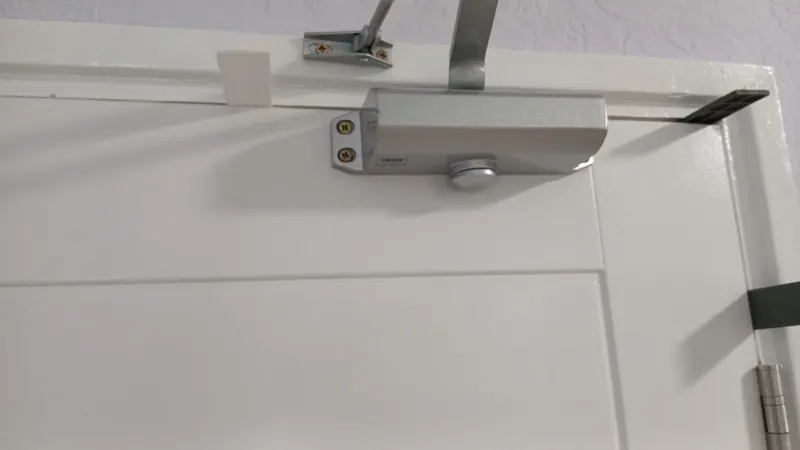
The photo on this page shows a closer on a door with two packers in the gap above it. That is a normal sight on a repair job. A closer needs something solid to sit against, and a worn frame does not give it that.
Why they fail
Hardly ever because the closer has died.
More often somebody has fiddled with it. Residents say the door is too heavy, a caretaker turns the speed valve right down, and from then on the door floats to a stop an inch short of the frame. We find that in blocks of flats all the time.
Then there are loose ones. A closer fixed into soft timber with short screws will wobble, then sag, then drop its arm.
And some doors have no closer at all, because a tenant took it off to stop the noise.
What we do on site
Open the door fully and let it go. Do the same from a few degrees open, because that is where latches fail.
Look at the mounting. Is the body tight? Is the arm bent? Are the screws biting?
Check the size of the closer against the door. They come in power ratings, and a narrow door can take a smaller one than a wide one. Too weak and the door will not latch against a draught.
Adjust it if it is sound. Replace it if it is not. Then test again, so you can see it working before we leave.
Props and hold-open
We fit closers. We cannot stop a person putting a fire extinguisher against the door the next morning.
If a door really needs to stay open, in a corridor with a lot of traffic, there are hold-open devices that release when the alarm sounds. That is a separate piece of kit. Ask us and we will say whether we can supply it or if your alarm company should.
Jobs we have done
Across two Luton secondary schools and an almshouse we dealt with 147 doors. 140 were repaired and stayed on their hinges.
Questions we get asked
Can I turn the valves on the closer myself?
You can, there's a screw for each. One sets the sweep, one sets the final snap onto the latch. Quarter turns only, and test the door after each one.
Do all fire doors need a closer?
Most do. A few doors that are kept locked shut, such as a riser cupboard, may not. Your report will say.
Send it with the postcode and we will price it one door at a time.
Get a price